Key Insights
See the Federal Marketplace More Clearly
Practical insight into how the federal marketplace actually works, where opportunity hides, and how capable businesses can position more intentionally to compete and grow.
The Federal Marketplace is the Most Misunderstood Market in Business
There has always been a formula for doing business with the Federal Government. Most never discover it.
The steps are there.
The guides are there.
The resources are there.
What’s missing are the skills and strategy inside each step.
Guides tell you to register in SAM.gov, create a capability statement, contact Small Business Offices, pursue contract vehicles, attend outreach events, and respond to opportunities.
What they rarely teach is how to execute those steps strategically enough to create visibility, relationships, positioning, pipeline, and revenue.
Most federal contracting resources have never walked in the shoes of a successful vendor on the sales side of this marketplace, navigating the buying network, building relationships, positioning before opportunities drop, and learning how to compound every effort into sustained federal growth.
Knowledge gaps make vendors easy prey.
They are sold fear around compliance, urgency, certifications, contract vehicles, and isolated services before anyone stops to ask:
Who actually buys what you sell? How do they buy it? And where should you position?
Without that clarity, companies spend money doing the right activities in the wrong order, or waste it entirely on efforts that never had a strategic foundation.
And those same knowledge gaps cause capable companies to give up before ever realizing their true potential inside this massive, revealing buying ecosystem, where opportunity can extend far beyond direct government awards into subcontracting, teaming, supplier relationships, and even new commercial business.
That Is the Gap.
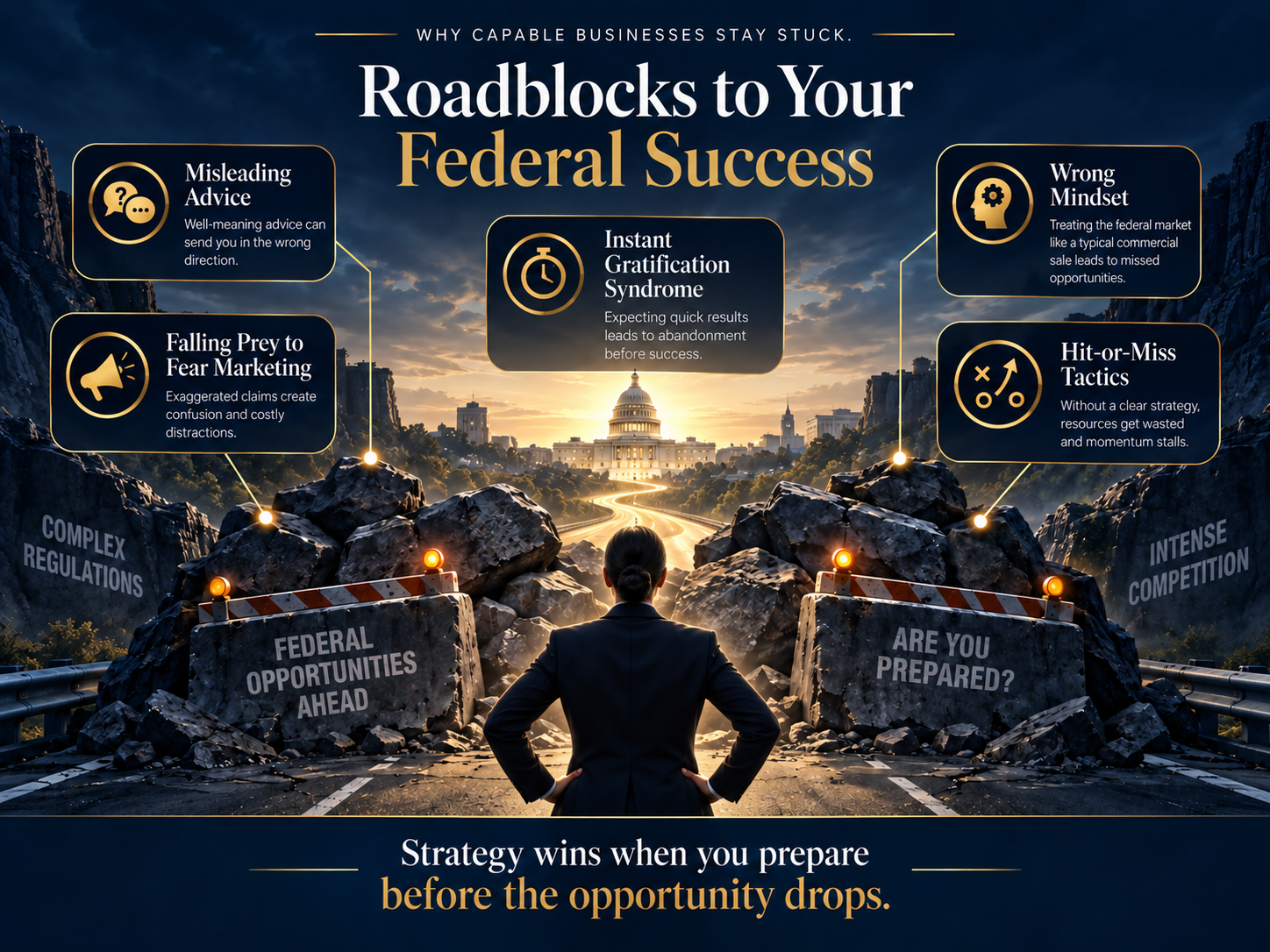
Why Capable Businesses Struggle
Most capable businesses don't struggle because they lack capability.
They struggle because they've been taught isolated tasks instead of how the federal marketplace actually works.
They learn SAM.gov.
They learn proposal writing.
They learn certifications.
They learn GSA.
They learn networking.
But almost no one teaches how all of those pieces work together.
The pieces are already there. The advantage comes from learning how they connect.
You already have access to far more federal marketplace intelligence than you realize.
The challenge isn't access to information.
It's learning how to see it—and how to connect it into a strategy.
Once you understand how the federal marketplace actually works, everything begins to connect.
You stop reacting to opportunities.
You start recognizing patterns.
You begin making intentional decisions instead of hopeful guesses.
Instead of chasing isolated opportunities, you build a repeatable federal growth strategy that compounds with every relationship, every positioning effort, and every contract award.
That's exactly why I created the Shadow Me™ Jumpstart Program.
Not to teach more tactics.
But to help businesses develop the mindset, skills, and strategy to navigate the federal marketplace with clarity, confidence, and intention.
____________
YES. There Is a Playbook to Winning Federal Contracts with Consistency.
Yet most vendors never learn it.
They limit themselves to chasing bids instead of roadmapping opportunities in advance, positioning in front of them, leveraging set-asides and contracting advantages, and maintaining an active opportunity pipeline.
Winning with consistency starts long before the bid drops.
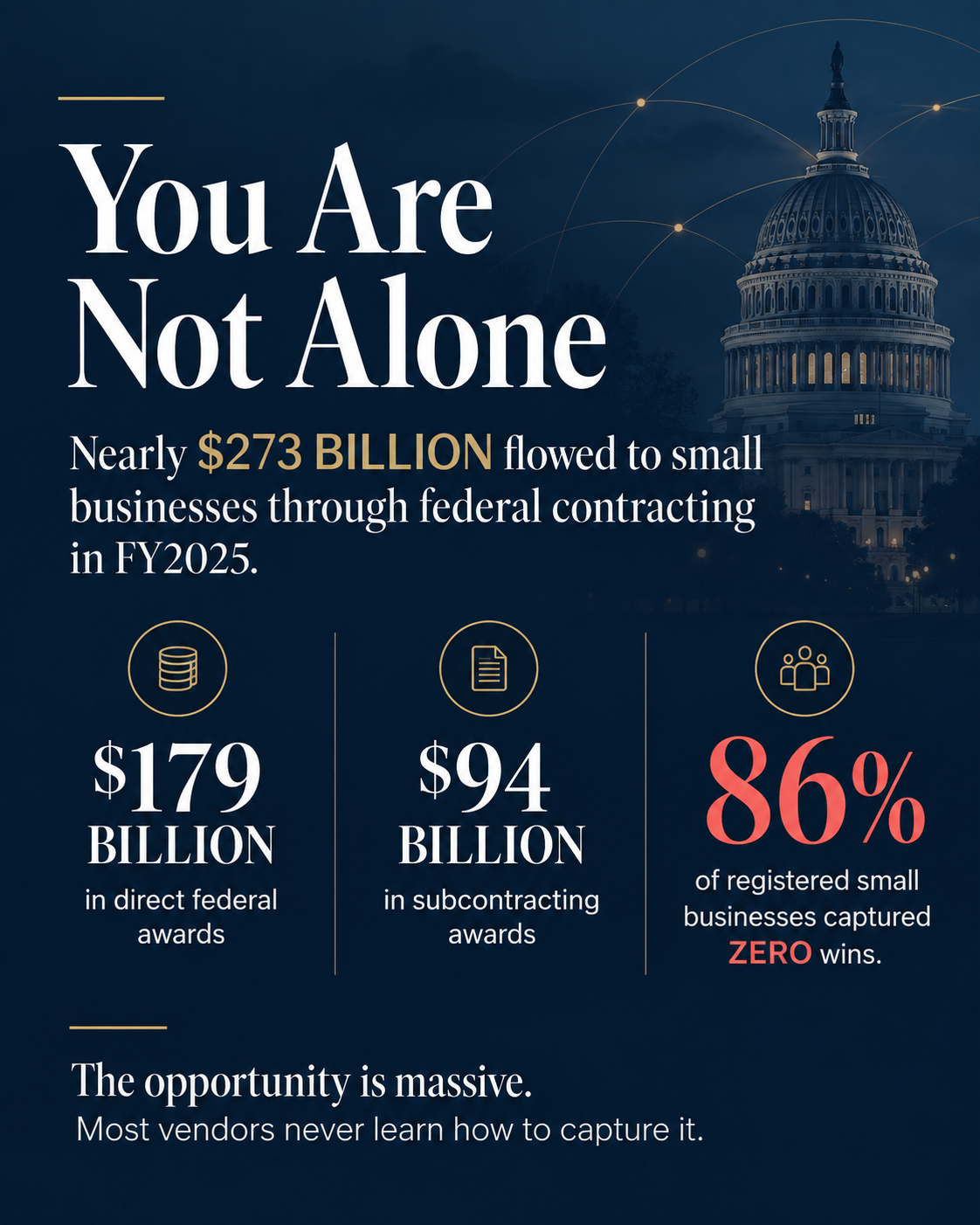
Sadly, GSA Schedules Do NOT Guarantee Sales
Too often, vendors are sold on “winning” a GSA Schedule.
The win is access, not revenue.
GSA Schedules can be costly to obtain and maintain
New sales requirements:
$100,000 during the first five years
$125,000 during each five-year period thereafter
Winning a GSA Schedule, BPA, or Other Contracting Vehicle Does NOT Guarantee Revenue
You still have to proactively market your win.
Millions are left on the table because companies do not know who to contact, how to communicate their value, how to stimulate task orders, or how to capture the opportunities their vehicle was designed to open.